Bike cassette wear: when to replace and how to check
Hooked teeth, chain skip: what to watch for
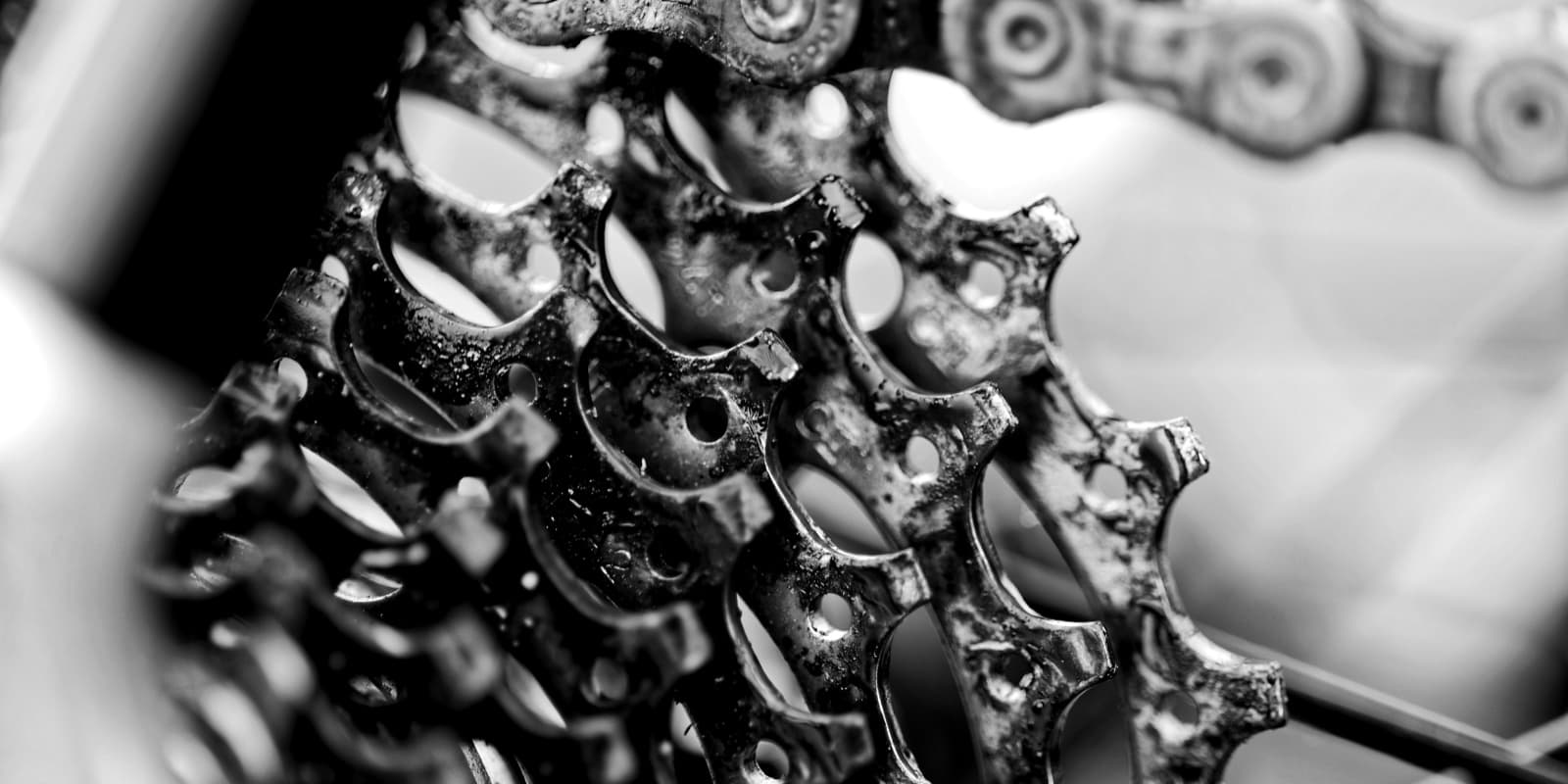
The cassette rarely wears out on its own. The chain always goes first - and if you let a worn chain ride too long, it starts filing down the cassette teeth with it. A chain replaced on time noticeably extends cassette life. And a worn cassette will destroy a new chain within a few hundred kilometres.
- New cassette (compatible standard)
- Chain whip
- Cassette lockring tool + handle
- Grease
How to spot a worn cassette
Three signs to look for, from most obvious to most subtle.
- Hooked teeth: on a new cassette, teeth are symmetrical. Worn, they become asymmetrical - one side straight, the other curved backward. Visible to the naked eye on small sprockets, harder to see on larger ones.
- Chain skip under load: when you push hard on a climb or sprint, the chain slips over one or more teeth instead of driving the sprocket. This is the most reliable sign of a dead cassette - if a new chain still skips, that settles it.
- New chain test: if you just replaced the chain and it skips from the first rides, the cassette is too worn to accept a new chain. The tooth profile no longer matches.
Visual inspection covers most cases. Cassette wear gauges exist but are rarely needed if you're already tracking your chain.
When to replace the cassette alone vs. both together
Simple rule: if the chain is replaced before reaching 0.75% elongation (measured with a checker), the cassette usually survives several chains. On well-maintained road bikes, you typically see 2 to 3 chain replacements per cassette.
Two situations where you need to replace both at once:
- Chain past 1% on the checker: it had enough time to wear the cassette. A new chain on those grooved teeth will skip immediately.
- New chain skips under load: even if the checker showed less than 1%, the teeth are too far gone to work with a new link.
On an MTB, gravel bike, or commuter exposed to mud and water, the ratio can drop to 1 chain per cassette - abrasion accelerates everything.
Replacing your cassette, step by step
With the right tools, the swap takes 20 to 30 minutes.
- 1
Check your freehub body standard
Shimano/SRAM HG (the most common), SRAM XD/XDR, or Shimano Micro Spline. An HG cassette won't fit on an XD body, and vice versa.
TipThreaded freewheel (older MTB, entry-level): you unscrew the whole block at once with a dedicated extractor, not a cassette tool. Follow a dedicated guide. - 2
Lock the cassette with the chain whip
Wrap the whip around a large sprocket to stop the cassette spinning while you unscrew.
- 3
Unscrew the lockring
With the cassette tool, unscrew counter-clockwise (like a standard screw), then pull off the old cassette.
- 4
Clean and grease the freehub body
With everything off, clean the freehub body and apply a light coat of grease to the thread. It prevents seizing after months of water exposure.
- 5
Fit the new cassette
Slide the sprockets on, matching the splines (one is wider as a keyway), and put the spacers back as they were.
- 6
Torque the lockring to 40 Nm
30 to 50 Nm depending on the manufacturer, 40 Nm is a safe default. Under-tighten and the cassette shifts; over-tighten and you risk stripping the thread.
What we see on ChainLog
From our current user base - still small - we're starting to see trends in chain/cassette ratios. On road bikes, most users who track their chain properly get 2 to 3 chain replacements before touching the cassette. On commuters and gravel bikes, that number is closer to 1 to 2.
These are early observations (likely selection bias - ChainLog users are probably more maintenance-conscious than average). We'll refine these numbers over time. The goal: eventually offer estimated lifespans by bike type and conditions.
Automatic tracking, so you don't have to think about it
Remembering to check the cassette every time you swap the chain, without an app, is easy to forget. What works: get alerted at the right time, check when swapping the chain, and log it in the app to keep the history.
ChainLog tracks kilometres per component, alerts when a check is due, and keeps a record of replacements. When the cassette is swapped, you log it - and its counter resets independently from the chain.
Not a perfect measurement. Just clean records, enough to know when to change what.