Bike bolt torque specs: the chart so you never lose a bolt
Chainring, stem, calipers, pedals: how tight each bolt should be, and why a torque wrench and threadlocker beat guessing.
My chainring is a Campagnolo Chorus. It came factory-mounted on the crank, bolts I'd never touched. 5,000 km and a crossing of the Pyrenees later, on Wednesday's ride, three of the four backed out on their own. Lucky they let go one at a time, not all at once out of the saddle on a climb.
My chainring came loose mid-ride
And the problem isn't wear. A chainring bolt doesn't wear out, it loosens: under-torqued at install, no threadlocker, and it slowly works its way out as you pedal.
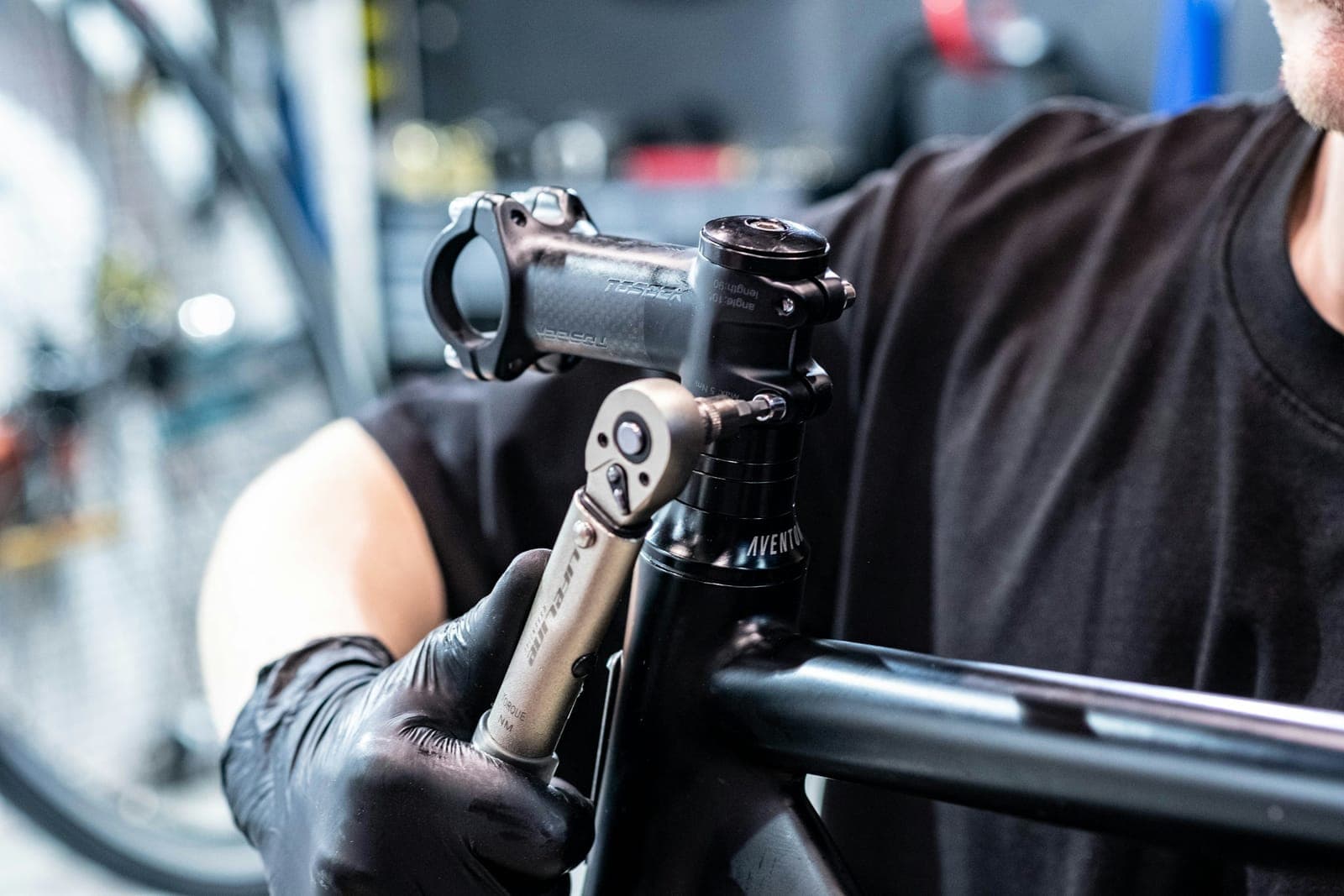
And the opposite happens too. A few weeks ago, on a multi-day trip in the Basque Country, I tightened a stem bolt with a mis-set torque wrench, too hard. The bolt snapped clean off, and the stub is still stuck in the stem. Too loose and it walks out, too tight and it breaks. You're aiming for the bit in between.
The fix is two things: torque to spec (with a properly set wrench), and use threadlocker where it belongs. Here's the reference chart, then the three rules that prevent the incident.
The torque chart
Typical ranges for a modern road or MTB bike, cross-checked against the Park Tool and Shimano references. But they're only ballpark figures.
| Component | Typical torque | Threadlocker? |
|---|---|---|
| Chainring bolts | ≈8-11 Nm (alloy: 5-10) | Yes |
| Hollowtech crank (pinch bolts) | 12-14 Nm | No |
| Bottom bracket (threaded) | 35-50 Nm | Sometimes |
| Stem, steerer clamp ⚠️ | 5-8 Nm | No |
| Stem, bar clamp ⚠️ | 5-8 Nm | No |
| Seatpost clamp ⚠️ | 4-6 Nm | No |
| Saddle rail clamp | 6-25 Nm (post-dependent) | No |
| Brake caliper mount | 6-8 Nm | No |
| Disc rotor bolts (6-bolt) | 2-4 Nm | Yes |
| CenterLock lockring | ~40 Nm | No |
| Cassette lockring | 30-50 Nm | No |
| Pedals | 35-40 Nm | No |
| Derailleur mount | 8-10 Nm | Sometimes |
| Bottle cage | 3-4 Nm | No |
| Thru-axle | 10-15 Nm (brand-dependent) | No |
- ⚠️ Carbon (stem, seatpost): never exceed the maker's number, and use carbon assembly paste rather than over-torquing for grip.
- Hollowtech II crank: the little end cap on the left crank arm is NOT a torque-wrench bolt. It's a play adjustment, screwed in by hand with almost no force. It's the two pinch bolts on the side of the crank arm (12-14 Nm) that actually hold it.
- Press-fit bottom bracket: it's pressed in, not torqued (the row above is for a threaded BB).
- Pedals: the left side has a reverse thread, it tightens and loosens the other way.
- Disc rotor bolts: medium threadlocker, unless the bolt already has a factory-applied blue patch.
The public references I cross-checked this chart against:
Why a bolt loosens (and it isn't wear)
A bolt holds by the tension it builds as it's tightened, not by the friction of its threads. Too loose, it doesn't have enough tension: with every load cycle (every pedal stroke, every impact) it relaxes a hair, and after a few hundred kilometres, it backs out.
That's why torque has no "lifespan" in kilometres: it isn't a wear part, it's a setting. A bolt torqued properly, with threadlocker where it belongs, won't move. A bolt tightened "by hand, feels fine" is a time bomb, exactly my Wednesday chainring.
The usual suspects: chainring, rotors, derailleur hanger, and anything that takes vibration and impacts.
The three rules that prevent it
Three habits, and you'll never find a bolt on the road again:
- A torque wrench, not feel. Guessing over-torques as often as it under-torques. A decent torque wrench costs about as much as a cassette, and saves you from buying another one.
- Always the maker's spec, especially on carbon. The chart gives ballparks; the exact value is on the part or in its manual. On carbon, exceeding it means cracking it.
- Medium (blue) threadlocker where recommended. Chainring, rotors, derailleur hanger: a drop on reassembly and the bolt won't back out. Blue comes apart later, red (strong) doesn't, stick to blue.
And after any reassembly, re-check the torque after the first proper ride. That's when under-torqued bolts give themselves away, while you can still catch them.
Keep a record of your installs
A bolt that loosens is almost always an install no one remembers: when, what part, with or without threadlocker.
ChainLog doesn't tighten your bolts for you and won't tell you the torque. That's the torque wrench and the manual. But it keeps a record of your installs: which part, when, with a note if you want (torque, blue threadlocker). Next time you wonder "when did I put that on again?", you have the answer. Free, syncs with Strava.
One place for all of it
Want one place for all of it? That's exactly what ChainLog does. Free, no ads, syncs with Strava.
Try ChainLog